Jgf 27 Inch 4K Monitor Review: Real User Experience After 3 Months
I've been using the Jgf 27 Inch 4K Monitor as my main screen for the last three months, and I wanted to share a candid, hands-on account of what it's like to live with it day to day. I bought this monitor to replace a 27" 1440p display I had used for years — primarily for photo editing, writing, streaming, and light gaming — and I wanted a sharper workspace without moving to a much larger screen. In this review I'll walk through setup, daily use, color and image quality, ergonomics, connectivity, software/OSD experience, and the things that pleasantly surprised me (and the things that irritated me).
Why I chose the Jgf 27" 4K
My main priorities were a 4K resolution on a 27" panel for dense text and precise image editing, an IPS-like color performance, height and swivel adjustability, and enough ports to connect a laptop and a desktop without constant cable swapping. The Jgf listing checked the boxes on paper and was priced attractively compared to other 27" 4K options. That made me take the plunge and replace my aging 1440p monitor.
Unboxing and first impressions
Out of the box, the monitor felt solid but not premium. The stand is mostly metal with some plastic trim; assembly was straightforward and I had it on my desk in under ten minutes. The included cables were basic: one DisplayPort and one HDMI. There was no USB-C cable included, and the manual is short but adequate.
The bezels are slim on the top and sides with a slightly thicker chin. The matte anti-glare coating is noticeable — it tames reflections well without making the image look grainy, which I appreciated immediately in a brightly lit room.
Setup and ergonomics
Setting it up was simple. The stand offers height adjustment, tilt, and swivel. I liked the range on the height adjust — I can move the screen high enough for a standing desk mount I sometimes use, and low enough for a relaxed, reclined posture. The tilt range is wide enough for my desk. There's a VESA pattern on the back if you prefer a third-party arm.
One small annoyance: the stand lug that secures the monitor to the stand required a firmer push than I expected, and the cable routing channel is shallow. If you use thicker USB cables, they can stick out a bit. The display does have a gentle wobble if you lightly tap your desk; it's not terrible, but more solid than ultra-premium models would be nicer.
Daily use: productivity and text
4K at 27 inches gives you roughly 163 PPI, and in my experience that jump from 1440p is very noticeable. Text looks crisp and small details in application UIs are much clearer. I primarily use Windows 11, and scaling at 150% keeps UI elements readable while making the extra screen real estate usable. At native 100% some menus and icons are tiny, but that’s not a fault of the display — it's the natural outcome of packing 3840x2160 into 27".
For spreadsheets, long documents, and multiple side-by-side windows, the added resolution is a huge productivity booster. I can comfortably place two documents side-by-side and still have room for toolbars and comment panes. In my experience, once you go 27" 4K for productivity, going back to 1440p feels cramped.
Color accuracy and creative work
Color was the main reason I upgraded. The Jgf panel on my unit leans slightly cool out of the box — whites have a faint bluish cast until you tweak settings or apply a basic calibration. I don't have a colorimeter at home, so I used a few sample images and online references to manually adjust the color temperature and gamma. After those tweaks, photos and videos looked natural and pleasing.
In practice, I found the panel delivers strong color for sRGB work. For web design and social media images, I had no complaints. If you're doing critical print work or professional-level color grading, you may want a factory-calibrated monitor or to calibrate with a hardware colorimeter. What I found was that for most creative freelance work, photography editing, and retouching for screen, the Jgf is perfectly capable.
Looking for the best Laptops & Computers deals on Amazon?
View Offers →Contrast, HDR, and brightness
The monitor has decent contrast for an IPS-style panel but it's not OLED — blacks are good but not inky. In dark scenes, shadow detail holds up well, and I didn’t notice severe glow. HDR is present but basic: it's the kind of HDR that improves highlights but doesn't deliver the punchier peak brightness and local dimming you'd get from higher-end HDR displays. In other words, HDR is a nice bonus for HDR-enabled video content but it's not a transformational feature on this unit.
Peak brightness in my daily usage is comfortable for my mostly well-lit home office. The display can get bright enough to cut through ambient light, and the matte coating helps. However, in direct sun it obviously falls short compared to a TV or a very bright monitor — something to keep in mind if your desk is near large windows.
Gaming and motion
I play casual games and spend occasional evenings in competitive shooters. The Jgf is a 60Hz panel (the typical configuration I purchased), and it handles casual gaming very well: frame pacing is smooth enough and input lag felt acceptable to me. Fast-paced competitive gaming with high frame rates will expose the 60Hz limitation, but if you’re a casual to moderate gamer who values image quality over refresh rate, this monitor is fine.
If you're a competitive gamer who needs 144Hz or more, look elsewhere — I was aware of this tradeoff when I bought the monitor and prioritized resolution and color over refresh rate. What I found was that single-player titles and visually rich games look gorgeous in 4K at medium-high settings, and the experience is immersive.
Connectivity and ports
The Jgf I bought includes two HDMI ports, one DisplayPort, and a small USB hub with two USB-A downstream ports. There’s also a 3.5mm headphone jack. My laptop supports USB-C video output, but this model does not have a USB-C input with power delivery, which surprised me slightly — I had hoped to use a single cable for video and charging. Instead, I run DisplayPort from my desktop and HDMI from my laptop and toggle inputs when switching.
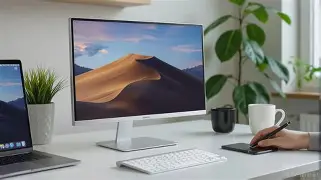
The USB hub is handy for a keyboard dongle and a thumb drive, but the hub is upstream via USB-B, so you’ll need to connect that to your machine for the ports to work. I keep one headset dongle plugged in and it’s been reliable. There’s no built-in KVM switching, which would have been a nice touch for someone who regularly switches between systems.
OSD and software
The on-screen display is controlled by a small joystick on the back. At first I found the joystick menu a little finicky — it's not as polished as on higher-end monitors — but after a day I got used to the navigation. The menu includes picture modes, color temperature, brightness, contrast, and a few gaming presets. I mostly run in a custom mode tuned to my preferences.
There is no bundled advanced calibration software. If you want color profiles that follow you across devices, you'll need to rely on your operating system or third-party tools.
Build quality and design
Build quality feels solid for the price bracket. The back has a textured matte plastic finish and a subtle branding emblem. The monitor isn’t flashy — there’s no RGB, no glass panel — which I like. The tilt, swivel, and height adjustment feel adequate. As mentioned earlier, there is a little wobble on my hollow desk when I type hard, but nothing disastrous.
Flaws I encountered
- Light backlight bleed on one corner when viewing very dark screens in a dim room — not severe, but noticeable on black backgrounds.
- No USB-C with power delivery, which would have simplified my laptop setup.
- 60Hz refresh rate only — not ideal for competitive gaming.
- OSD joystick navigation is a touch clunky initially.
- Included cables are basic; if you want crisp 4K at 60Hz with full features you may want higher-quality DisplayPort/HDMI cables.
Pros & Cons
What I appreciated (Pros)
- Sharp, dense workspace: 4K at 27" gives excellent clarity for text and multitasking.
- Good color for everyday creative work: After minor tweaks, images looked accurate enough for web and social delivery.
- Comfortable ergonomics: Height, tilt, and swivel made it easy to get a comfortable setup for long editing sessions.
- Matte finish: I liked the anti-glare coating; it reduces reflections without obvious graininess.
- Value: For what I paid, the balance of features to price made sense for my needs.
What bothered me (Cons)
- No USB-C power delivery: I missed the single-cable convenience for my laptop.
- Basic HDR: HDR is more of a slider than a meaningful improvement for brightness and contrast.
- 60Hz cap: If you want smooth high-frame-rate gaming, this isn't the model to pick.
- Minor backlight bleed: Visible in very dark rooms with black content.
- OSD interface: Functional but could be more polished.
Comparison table
| Feature | Jgf 27" 4K (This Review) | My old 27" 1440p | 32" 4K TV I used as monitor |
|---|---|---|---|
| Resolution | 3840 × 2160 (4K) | 2560 × 1440 (QHD) | 3840 × 2160 (4K) |
| Panel type | IPS-like (wide viewing angles) | IPS | VA (better contrast but narrower viewing angles) |
| Refresh rate | 60Hz | 75Hz | 60Hz |
| Pixel density (approx.) | 163 PPI | 108 PPI | 138 PPI |
| HDR | Basic HDR support | No | Basic HDR on some models |
| Ports | DP, 2× HDMI, 2× USB-A, 3.5mm | DP, HDMI | HDMI (limited inputs), often no PC-friendly hub |
| Stand adjustments | Height, tilt, swivel, VESA | Tilt only | Limited (tilt on stands), VESA on many models |
| Speakers | Basic built-in speakers | None | Often included and louder |
| Ideal use | Productivity, creative work, casual gaming | General office work, light gaming | Media consumption, casual PC use |
Buying guide: is this monitor right for you?
Here are some quick questions I asked myself before choosing the Jgf, and how I think the monitor stacks up depending on your needs. I found thinking through these helped me be satisfied with my purchase.
Shop the latest Laptops & Computers picks on Amazon.
Browse Now →Do you need native 4K at 27"?
If you want very sharp text and the ability to fit more windows without jumping to a larger screen, yes. In my experience, the 27" 4K sweet spot gives you that clarity without turning everything into tiny UI elements when you use sensible scaling.
Are you a competitive gamer?
No — if you chase 144Hz or 240Hz competitive performance, this isn't the right choice. I was okay with 60Hz because I value screen real estate and image quality more than high refresh rates.
Do you need a color-critical monitor?
For web content, social images, and general photo editing, this monitor is fine. For pro print work or broadcast-level grading, budget to add a colorimeter or opt for a factory-calibrated pro monitor.
Is USB-C with power delivery essential?
If you want a single cable for video and laptop charging, note that this Jgf model doesn't include it. I learned to live with separate power and video cables, but I would have preferred a USB-C option.
Do you want a built-in KVM or advanced hub features?
Not included. If you switch frequently between two computers and want a seamless peripheral handoff, look for a monitor with KVM or a more extensive USB hub.
Practical tips from my three months with it
- Spend 10–15 minutes in the OSD adjusting color temperature from the cool default — moving it slightly warmer often improves skin tones and reduces eye fatigue.
- If you plan to do color work, consider a basic calibration session with free software or, for best results, a hardware colorimeter.
- Buy a good quality DisplayPort or HDMI cable that supports full 4K at 60Hz; the included cables can work but a sturdier cable avoids occasional handshake issues.
- Use scaling (Windows 11: 150%) if UI elements feel too small — full native 100% makes many apps tiny.
- If your desk is wobbly, a solid monitor arm (VESA) will remove the slight wobble I mentioned and free up desk space.
Final thoughts and conclusion
After three months of daily use, the Jgf 27 Inch 4K Monitor has become my go-to screen for work and entertainment. What I found was a reliable, sharp, and mostly color-accurate display that improved my productivity immediately and made creative tasks more enjoyable. The stand is functional, the matte coating is comfortable for long work sessions, and overall build quality is good for the price.
My disappointments are real but manageable: no USB-C power delivery, a 60Hz refresh cap for gamers, and a little backlight bleed in very dark scenes. None of those are deal-breakers for my use case, but they're worth knowing before you buy.
In my experience, this monitor is an excellent mid-range choice for someone who wants the clarity of 4K on a 27" screen without paying pro-monitor prices. If you prioritize ultra-smooth gaming, single-cable laptop docking, or factory-calibrated color for print work, you should compare other models. If, like me, you want crisp text, more workspace, and good color for everyday creative work, the Jgf has delivered solid value and lived up to my expectations after three months on my desk.